

Loading the player...
Health and Safety Committee – Refresher Course
Topic 2: The Legal Framework
Current Terminology |
| Victoria |
All other States and Territories |
| Occupational Health and Safety (OHS) | Work Health and Safety (WHS) |
| OHS Act | WHS Act |
| OHS Regulations | WHS Regulations |
| Compliance Codes | Codes of Practice |
| Employer | Person Conducting a Business or Undertaking (PCBU) |
| Employee | Worker |
| Officer (top level management) | Officer (top level management) |
| Health and Safety Committee (HSC) | Health and Safety Committee (HSC) |
| Health and Safety Representative (HSR) | Health and Safety Representative (HSR) |
Which documents make up “The Legal Framework”
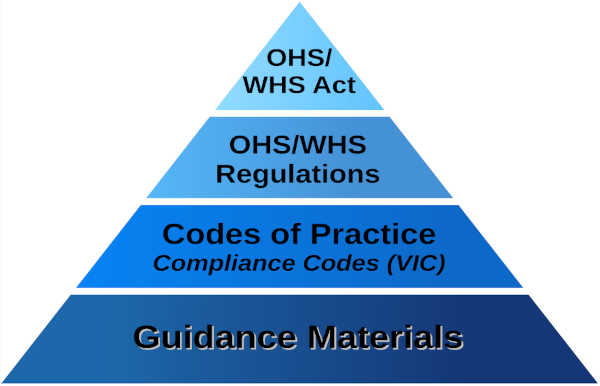
- The OHS/WHS Act
An Act (principal legislation) is a set of legal rules and duties, passed by parliament, that parties need to comply with and follow. - The OHS/WHS Regulations
The WHS Regulation is also law (subordinate legislation) and contain many details to support the duties established in the Act. - Codes of Practice
Codes of Practice are best safety practice documents that assist duty holders to comply with the legislation.Codes of Practice are developed by SafeWork Australia in consultation with industry. They are admissible in court proceedings as evidence of what is known about a hazard, risk or control, and may be used to determine what is ‘reasonably practicable’ in the circumstances that the code relates to.
It’s recognised that equivalent or better ways of achieving the required work health and safety outcomes may be possible. For that reason, compliance with codes of practice is not mandatory — providing that any other method used provides an equivalent or higher standard of work health and safety than suggested by the code of practice.
An inspector can also refer to a code of practice when issuing an improvement or prohibition notice. - Compliance Codes (Victoria Only)
Compliance Codes assist duty holders to comply with the legislation and they are admissible as evidence in legal proceedings.
Compliance Codes are developed by WorkSafe Vic. Compliance codes are not mandatory, however, a duty holder who complies with a code will – to the extent it deals with their duties or obligations under the OHS Regulations – be considered to have complied with those duties or obligations - Guidance Materials (Interpretive Guides)
Guidance materials are designed to assist duty holders to meet the requirements as set out in the legislation. Guidance materials include AS/NZ Standards, fact sheets and safety alerts, the Regulator website etc.
Australian Standards are developed in consultation with industry and assist duty holders to meet their obligations. If an Australian Standard is referred to in the legislation, then duty holders must fully comply with that Standard. These Standards however, do not replace the duties and obligations imposed by the OHS/WHS Act and Regulation.
WorkSafe Victoria also publishes “WorkSafe Positions”. These explain how WorkSafe Vic will interpret the law.

Quizzes