

Health and Safety Committee – Refresher Course
Topic 9 – Risk Management
Risk management is a process that includes four steps and these steps are:
| Step One | Hazard Identification |
| Step Two | Risk Assessment |
| Step Three | Risk Control |
| Step Four | Review risk control measures |
And, of course, consultation with relevant workers must occur throughout all four steps. So let’s review each of those steps.
Step 1 – Hazard Identification
A hazard is really anything that can cause physical and/or psychological harm to a person.
There are a variety of tools and processes available to assist you in hazard identification such as checklists, communication processes, safety alerts, incidents. And, of course, your own work experience and senses such as as vision, hearing, smell are amongst the most useful tools at your disposal. Never ignore your senses.
Sometime ago I had a civil engineer come through one of my classes. They just built this massive bridge structure, and as he was walking along it, he heard these strange cracking noises. And in the 10 years that he’d been in the industry, he had never heard something like that before. So he didn’t know what it was, but it didn’t sound right to him. So what did he do? He started to run and just as well he did, because a few moments later the structure collapsed and he would have been killed. So the importance of acting on your senses cannot be overstated.
Step 2 – Risk Assessment
A risk assessment involves considering what could happen if someone is exposed to a hazard
In doing so, it looks at both the likelihood a hazard may cause harm and the potential severity of the harm.
To assist with this process, there are many different examples of risk assessment matrices available in industry. And the one that you see below is one of the more common ones. each organization should make their own choice regarding what matrix is most suitable for their circumstance.

Across the top of this matrix, you will see five levels of likelihood.
Down the side, you will see five levels of consequence. So let’s just apply this to an example.
In the picture below, you will see a blocked emergency exit. This means that in an emergency, people will not be able to safely evacuate the building.
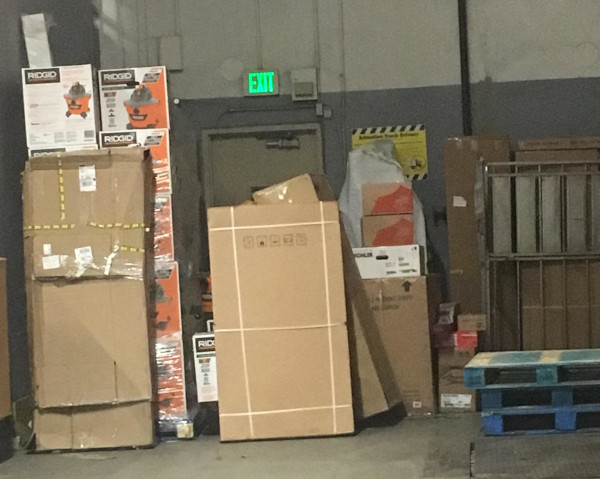
The likelihood of an emergency may be unlikely but the consequence can be catastrophic. If you now cross-reference the corresponding columns in the risk matrix, it will give you a risk assessment outcome of extreme.
It is important to define the meaning of each level of risk. For instance, if you assess a risk to be low, you may accept the risk, continue with work and may be improve the situation when a opportunity arises. But if you assess a risk to be extreme, it may require to stop work immediately and not to continue until the risk is managed to an acceptable level.
Risk assessments are very subjective and each person may bring up different views of a situation. In these cases, management must consider and take into account each view before making decisions on how to proceed.
Risk assessments should be done when there is uncertainty about how a hazard may result in injury or illness or, the work activity involves a number of different hazards and there is a lack of understanding about how the hazards may interact with each other or, changes at the workplace occur that may impact on the effectiveness of control measures.
Risk assessments are mandatory under the safety regulations for certain activities for instance for confined space entries or live electrical work. The OHS/WHS regulations must be checked for further details regarding when risk assessments are required for the activities in your organization.
Step 3 – Risk Control
After assessing risk, you must control the risk. When identifying risk controls, the use of a system called the “Hierarchy of Control” is mandatory under the safety laws.
The hierarchy of control is a set of six questions that must be considered from the top down:
| 1 | Eliminate the risk |
| 2 | Substitute the hazard with something safer |
| 3 | Isolate the hazard from the person |
| 4 | Implement engineering controls |
| 5 | Implement administrative controls |
| 6 | Provision and use of Personal Protective Equipment (PPE) |
Eliminating the hazard or risk is not always possible. But regardless how feasible this option is, it must be considered.
The second consideration is considering substituting the hazard with something safer. For instance if you are using a hazardous chemical you must consider whether you can use a less hazardous or non hazardous chemical for the job.
The third consideration is about isolating the hazard from any person exposed to it.
The fourth consideration of engineering controls include for example, machine guards, lifting equipment, trolleys, safety switches and so on.
The fifth consideration of implementing administrative controls is when you start telling people what to do. Examples are safe operating procedures, swims, signage, training, supervision etc.
And the final option is the use of personal protective equipment or PPE.
As the below diagram shows, the higher the controls are up in the hierarchy, the more effective they are considered to be.
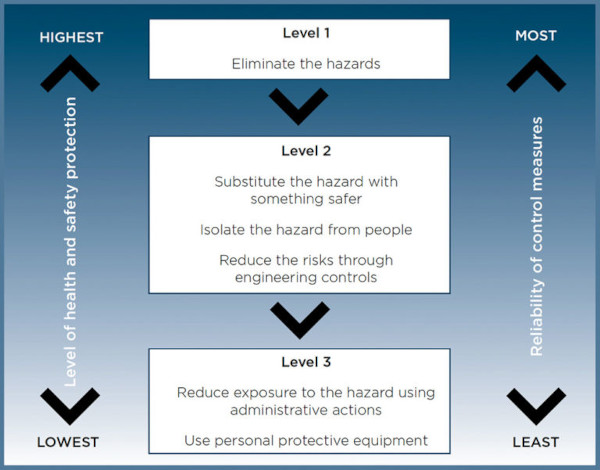
Most of the time when using the hierarchy of control, you will end up with multiple levels from the hierarchy for instance if you are dealing with an unguarded noisy machine, you may end up with machine guarding which is an engineering control, plus safe operating procedures which is an administrative control and to further minimize the noise exposure to a person you may implement hearing protection. So in this example, three levels of the hierarchy of control are implemented.
Step 4- Review risk control measures
At this point we look at whether the controls are in place, are used, are effective and/or whether they can be improved.
Any implemented control may seem to be the best possible option at the time of implementation but whether they really are, time will only tell. Technologies and or the workplace may also have changed since the initial implementation which could mean that he existing controls are no longer as effective or, that new more effective controls have become available.
Consultation with relevant workers must occur during each of the four risk management steps.
After proper consultation has taken place, management is in a position to make informed decisions regarding how to manage risk under the circumstances.
Of course, the safety committee plays a significant role here in helping to ensure that management makes the best possible and informed decisions.