
Lesson 1 – Topic 1; The Legal Context
This course is made up of 2 lessons and provides a pro active approach to help avoid psychological injury in the workplace.
In lesson 1 we are going to look at examples of psychosocial hazards, how to manage these and what health and safety laws apply.
In lesson 2 we will give you strategies to turn your workplace into a “kind workplace”.
A kind workplace is a workplace where workers are valued, respected and treated fair. This in turn will have a positive effect on worker morale and overall business results.
Kind Workplaces are Good for Business.
So first, let’s have look the safety laws.
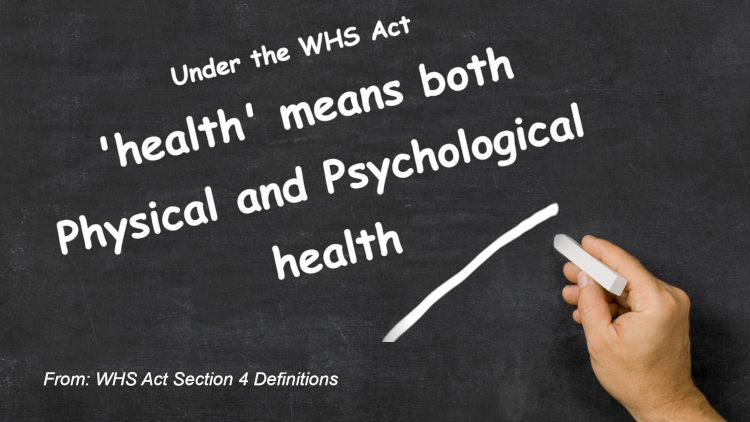
It is important to understand that under the Work Health and Safety (WHS) Act “health” is defined to both mean physical and psychological health.
This means that an employer must ensure, so far as is reasonably practicable, the psychological health of workers while the workers are at work in the business or undertaking. (Under the WHS Act, employers are now referred to as ‘Person Conducting a Business or Undertaking’ or PCBU).
Therefore, just like physical hazards, psychosocial hazards must be managed as well.
All people in the workplace have duties to achieve a safe and healthy workplace but the primary duty of care to ensure a safe workplace lies with the Person Conducting a Business or Undertaking or PCBU.
A PCBU can be a natural person such as a Self Employed person or Sole Trader, but many times it will be a legal entity such as a company.
In case of a company, top level management such as CEOs, directors and in some cases senior managers have a specific WHS duty called “Due Diligence”.
Top level managers must exercise this due diligence to ensure that the PCBU meets its primary duty of care.
This duty includes taking reasonable steps to gain an understanding of the psychosocial hazards and risks that arise from business activities and to ensure that there are appropriate resources and processes in place to manage psychosocial hazards effectively.
Of course, all workers, regardless what level they are at within the hierarchy, have duties under the safety legislation as well.
All workers must comply with reasonable instructions from the PCBU, cooperate with policies and procedures they have been notified of, take reasonable care for their own health and safety and they must take care that their acts or omissions do not adversely affect the psychological health of other workers.
Very similar duties are placed on “others” in the workplace such as visitors, shoppers or members of the public.
So all in the workplace have legal duties with regards to psychological health.
Under the safety laws, severe penalties and even jail sentences can be handed out to persons for not meeting their legal duties.
It is also important to realize that safety laws do not operate in isolation. Other laws for example: criminal, anti-discrimination, privacy and Fair Work legislation may also be relevant when managing psychological health.