

WHS Due Diligence for CEO’s Directors and Managers – TAS edition
Topic 2 – The Legal Framework
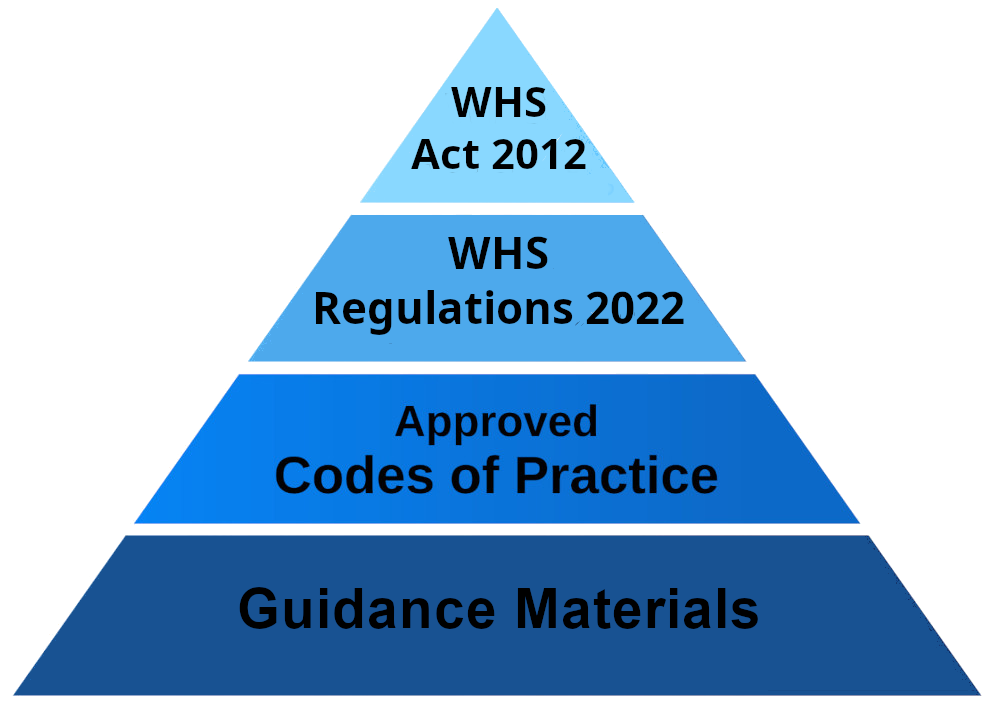
The Work Health and Safety (WHS) Act 2012
The WHS Act 2012 is a book of legal rule, passed by parliament.
It sets out the purpose of the law (objects) and also specifies its broad principles as to how this law is to operate. It identifies duty holders and their legal duties.
The Act also contains enforcement and compliance provisions including the role and functions of the regulator, WorkSafe TAS.
Purpose of the WHS Act 2012:
The WHS Act provides a framework to protect the health, safety and welfare of all workers at work and of other people who might be affected by the work. The WHS Act aims to:
- protect the health and safety of workers and other people by eliminating or minimising risks arising from work or workplaces
- ensure fair and effective representation, consultation and cooperation to address and resolve health and safety issues in the workplace
- encourage unions and employer organisations to take a constructive role in improving
work health and safety practices - assisting businesses and workers to achieve a healthier and safer working environment
- promote information, education and training on work health and safety
- provide effective compliance and enforcement measures, and
- deliver continuous improvement and progressively higher standards of work health and safety.
In furthering these aims regard must be had to the principle that workers and other persons should be given the highest level of protection against harm to their health, safety and welfare from hazards and risks arising from work as is reasonably practicable.
For these purposes ‘health’ includes psychological health as well as physical health.
The WHS Regulations 2022
The WHS Regulations are also legally binding and provide more detailed requirements to support the duties that are set out in the WHS Act 2012. They also prescribe procedural or administrative requirements to support the WHS Act (for example requiring licences for specific activities and keeping records).
Approved Codes of Practice
Approved Codes of Practice are practical guides on how to comply with the legal duties under the WHS Act and Regulation. To determine if a Code of Practice has been approved in a particular jurisdiction, check with your local WHS regulator.
An approved code of practice applies to anyone who has a duty of care in the circumstances described in the code.
While approved codes of practice are not law, codes of practice have a special status because an approved code is automatically admissible as evidence in court proceedings under the WHS Act and Regulations. Courts may have regard to a code as evidence of what is known about a hazard, risk or control and may rely on the code in determining what is reasonably practicable in the circumstances to which the code relates.
You should always follow a code of practice.
Alternative procedures must achieve the same or higher level of safety compared to, had you followed the code of practice exactly. (Refer to WHS Act s275)
Ignoring or not acting on a code of practice may mean you are not meeting your duty of care.
Codes of practice:
- deal with a duty or obligation under the WHS Act or Regulations
- include known information about particular hazards, risks and control measures
- help in determining what is reasonably practicable in the circumstances, and
- can be supplemented with other types of guidance material.
Guidance Material
Guidance materials such as fact sheets, safety alerts, regulator websites, also help duty holders comply with the law but differ from the authoritative advice of a code of practice by allowing duty holders wider discretion to choose the options that best suit their circumstances.
Guidance material contributes to the overall state of knowledge regarding hazards, risks and controls and may also be tendered as evidence in court proceedings.
As with approved codes of practice, ignoring or not acting on guidance material may mean that you are not meeting your duty of care