

WHS for Health and Safety Committees – SA Edition
Lesson 1 – Topic 1: The Legal Framework
| Old Terminology | Current Terminology |
| OH&S | WHS (Work Health & Safety) |
| Employer | Person Conducting a Business or Undertaking (PCBU) |
| Employee | Worker |
| OHS Representative | Health & Safety Representative (HSR) |
| OHS Committee | Health & Safety Committee (HSC) |
| General Managers, Directors | Officers |
| Authorised Officers (Union Officials) | WHS entry permit holders |
Documents that make up “The Legal Framework”
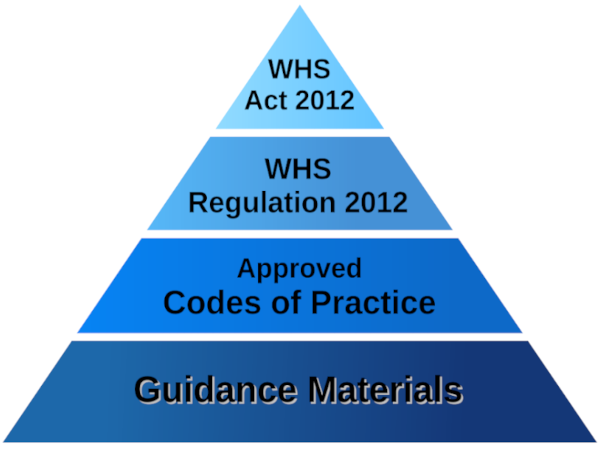
- The WHS Act 2012
An Act (principal legislation) is a set of legal rules and duties, passed by parliament, that parties need to comply with and follow. - The WHS Regulation 2012
The WHS Regulation is also law (subordinate legislation) and contain many details to support the duties established in the Act. - Approved Codes of Practice
Codes of Practice are best safety practice documents that assist duty holders to comply with the legislation.Codes of Practice are developed by Safe Work Australia in consultation with industry and approved by the relevant minister. They are admissible in court proceedings as evidence of what is known about a hazard, risk or control, and may be used to determine what is ‘reasonably practicable’ in the circumstances that the code relates to.
It’s recognised that equivalent or better ways of achieving the required work health and safety outcomes may be possible. For that reason, compliance with codes of practice is not mandatory — providing that any other method used provides an equivalent or higher standard of work health and safety than suggested by the code of practice.
An inspector can also refer to a code of practice when issuing an improvement or prohibition notice. - Guidance Materials
Guidance materials are designed to assist duty holders to meet the requirements as set out in the legislation. Guidance materials include AS/NZ Standards, fact sheets and safety alerts, the SafeWork website etc.
Australian Standards are developed in consultation with industry and assist duty holders to meet their obligations. If an Australian Standard is referred to in the legislation, then duty holders must fully comply with that Standard. These Standards however, do not replace the duties and obligations imposed by the WHS Act and Regulation.

Objectives of the WHS Act 2012:
The main object of this Act is to provide for a balanced and nationally consistent framework to secure the health and safety of workers and workplaces by:
- protecting workers and other persons against harm to their health, safety and welfare through the elimination or minimisation of risks arising from work or from specified types of substances or plant;
and - providing for fair and effective workplace representation, consultation, cooperation and issue resolution in relation to work health and safety; and
- encouraging unions and employer organisations to take a constructive role in promoting improvements in work health and safety practices, and assisting persons conducting businesses or undertakings and workers to achieve a healthier and safer working environment; and
- promoting the provision of advice, information, education and training in relation to work health and safety; and securing compliance with this Act through effective and appropriate compliance and enforcement measures; and
- securing compliance with this Act through effective and appropriate compliance and enforcement measures; and
- ensuring appropriate scrutiny and review of actions taken by persons exercising powers and performing functions under this Act; and
- providing a framework for continuous improvement and progressively higher standards of work health and safety; and
- maintaining and strengthening the national harmonisation of laws relating to work health and safety and to facilitate a consistent national approach to work health and safety in this jurisdiction (South Australia).
The guiding principle of the WHS Act is that all people are given the highest level of health and safety protection from hazards arising from work……
“SO FAR AS IS REASONABLY PRACTICABLE”
So what is meant by “reasonably practicable”? It means weighing up matters such as:
- Likelihood of hazard or risk occurring. E.g: The likelihood the hazard is causing an injury.
- Degree of harm that might result. E.g: Type of injury and level of severity the hazard may cause.
- What a person knows, or ought reasonably know, about hazards or risks and ways to eliminate or minimize these.
For example: You hire a third party to do work for you. It is your understanding that this person will work by him/herself. However, this person now brings an apprentice along and does not let you know. Are you responsible for the safety of the apprentice?….YES you are because you ought to have known there was an additional person. HOW would you have known? … through sign in procedures, supervision, induction etc. Similarly, you ought to know about Codes of Practice that are relevant to the work to be carried out. Ignorance is no defense. - Availability/Suitability of ways to eliminate or manage risks. E.g.
Availability: Overseas control measures have a restricted availability.
Suitability : Suitability of controls is determined using the Hierarchy of Control. (S36 WHS Regulation 2011) - After assessing the above, the cost of eliminating/managing hazards and risks.
Cost should not be disproportionate to the risk. However, cost will never be an excuse to do nothing or not enough.
So as a minimum, these are issues that will be considered by a regulator or court, in judging whether an action was reasonable and or practicable for a person to undertake or not under the circumstances.